Two Rivers, One City: Why Your Viking Dishwasher Scales Faster in Desert Ridge Than in Encanto
Phoenix taps run on two different rivers depending on the treatment plant, but the number that matters is hardness: 172 to 302 ppm, or 10 to 17.6 grains per gallon, system-wide. Both sources scale a Viking dishwasher, so the fix is an interval, not a new machine.
Phoenix does not have one water. Five treatment plants split the city by river: the 24th Street plant, rated 140 million gallons a day, and Deer Valley and Val Vista treat Salt River Project water off the Salt and Verde, while Union Hills, rated 160 MGD, and Lake Pleasant treat Colorado River water arriving down the Central Arizona Project canal. Union Hills is the plant feeding north Phoenix, Desert Ridge included.
The question worth asking first
Which river is on your street is a genuinely interesting question, and for appliance purposes it is the second one. Ask the first one instead: how hard is the water, in grains, at your tap. The City of Phoenix 2025 Water Quality Report puts total hardness across the distribution system at 172 to 302 ppm — 10 to 17.6 grains per gallon — with total dissolved solids of 464 to 716 ppm.
Read that range honestly and the source split stops being a decision. The soft end of Phoenix’s range is what other cities call hard. A Desert Ridge dishwasher on Colorado River water and an Encanto dishwasher on Salt-Verde water are both scaling; the northern one may simply get there on a slightly different schedule. The report also notes that roughly 97 to 99 percent of the 2025 supply was surface water, with the remainder drawn from about twenty city groundwater wells — so for most addresses this is river water, treated, and mineral-loaded either way.
What shortens an appliance life here specifically
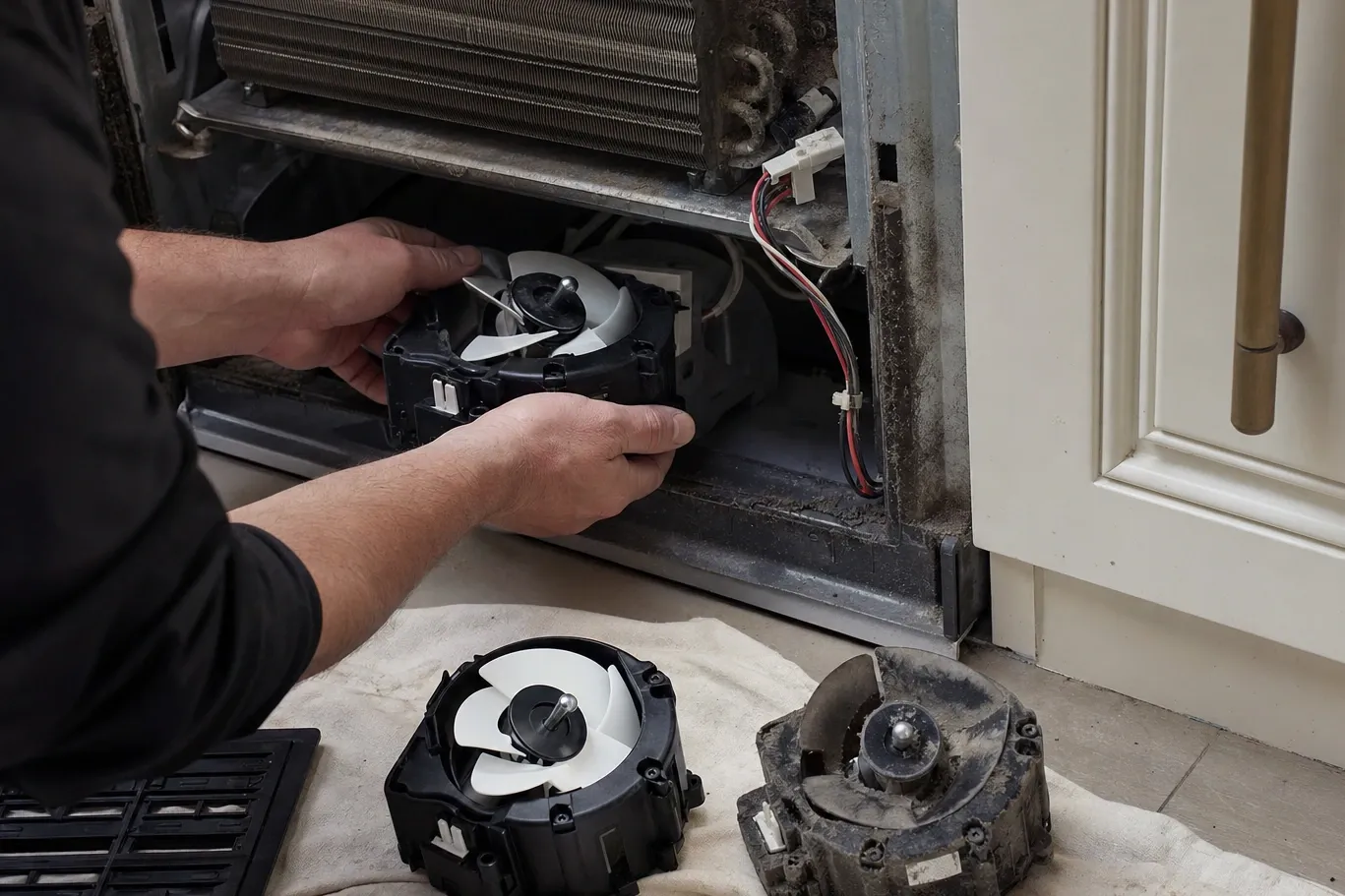
Scale, and specifically scale on heated wet surfaces. In a Viking dishwasher the vulnerable parts are the heating element, the spray arm jets, the fill valve and the filter, and the mechanism is the same in each: dissolved mineral comes out of solution where water is hottest or where it evaporates, and the deposit narrows an opening or insulates a surface. On the refrigeration side it is the ice maker fill valve and mould that go the same way.
The visible consequences arrive in a familiar order. Glassware films over and detergent seems to stop working. Then the dishwasher takes longer, because a scaled element transfers heat less efficiently and the cycle extends to reach temperature. Then jets clog unevenly and one rack stops getting clean. Then the fill valve either sticks or restricts. None of this is a defect, and it is not the machine giving up early — it is 10-to-17.6-grain water doing arithmetic.
Willo and Encanto owners feel it in older plumbing that adds its own deposit; Camelback East and Desert Ridge kitchens feel it most in ice and in second refrigerators standing in a hot garage, where the appliance is fighting mineral and heat at once.
Reading the machine you already own
Look at the machine before you look at a catalogue. Pull the lower rack and the filter and inspect the element and the sump for white or grey crust. Pop the spray arms off and hold them to the light — blocked jets show immediately, and a partially blocked arm produces exactly the one-side-not-clean complaint people blame on the pump. Check whether cycles have quietly got longer. Look at the door seal for chalky build-up that stops it sealing evenly.
For the ice side, examine the cube: hollow, cloudy or fused cubes and falling production point at fill and freeze rather than at the module. Check the filter’s date. Then check the obvious thing nobody checks, which is whether a water softener or conditioner in the house is actually working, since a bypassed or exhausted unit turns a protected appliance into an unprotected one overnight.
Repair, or start again
Scale is a maintenance failure, not a death sentence, and the arithmetic usually favours repair. A dishwasher pump or control runs $210 to $410, a refrigeration fan or defrost system $280 to $680, an igniter or burner assembly $190 to $430, an oven thermostat or heating element $190 to $480, a control board or touch panel $470 to $650. Against the cost of a new professional appliance, those are small numbers.
The line to watch is the sealed system. Compressor or sealed-system repair runs $1,300 to $2,970, and at that level the age and condition of the rest of the cabinet decides whether it is worth doing. The other honest answer is that replacing a scaled machine without changing the water changes nothing: the new one meets the same 10-to-17.6-grain supply and starts the same clock.
What a diagnosis gives you
An $89 diagnostic call produces three things: the actual fault, the extent of the scale, and a descaling and filter interval matched to your address rather than a city average. That last item is the part with the longest payback, because in this water the interval is what preserves the appliance.
It also settles the softener question with evidence — whether you need one, whether the one you have is doing anything, and which appliances in the house are worth feeding from it first. (480) 605-8687 — say what changed and roughly when it started.
Follow-up questions
- Which Phoenix treatment plant supplies my house?
- North Phoenix, Desert Ridge included, is served by Union Hills, which treats Colorado River water delivered down the Central Arizona Project canal. Central neighbourhoods drink Salt and Verde river water through the 24th Street plant. For appliance care that changes the timing more than the advice, because even the soft end of the city-wide range is hard water.
- Will a water softener stop my dishwasher scaling?
- It reduces the load substantially, which is why softened houses show far less deposit on elements and spray jets. Two caveats apply: the appliance actually has to be downstream of the softener, and the softener has to be maintained, because a bypassed or exhausted unit quietly puts you back on full hardness. Both get checked during the diagnosis.
- Is it cheaper to replace a scaled dishwasher than to repair it?
- Rarely, and replacing it does nothing about the cause. Pump or control work runs $210 to $410, set against the price of a new professional machine that meets identical water on its first day. Unless the cabinet itself is failing, descaling plus the repair is the better arithmetic, followed by an interval that stops the deposit returning.